Research Project · Machine Knitting
Knitted Acoustic Barcode
A knitted barcode that embeds binary data in the spacing between raised garter regions and decodes it from acoustic waveforms captured while sliding across the fabric.
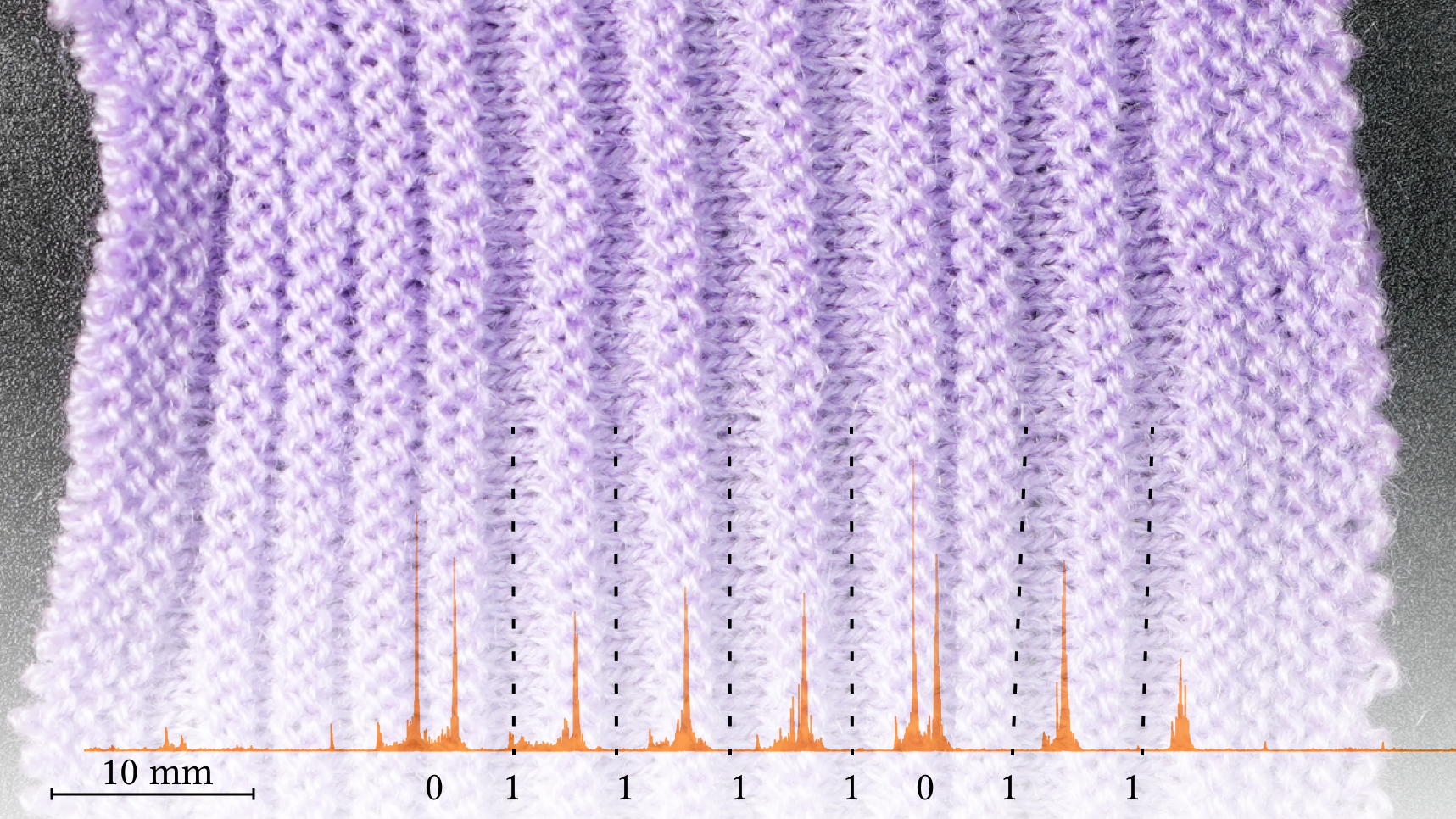
Physical Representation
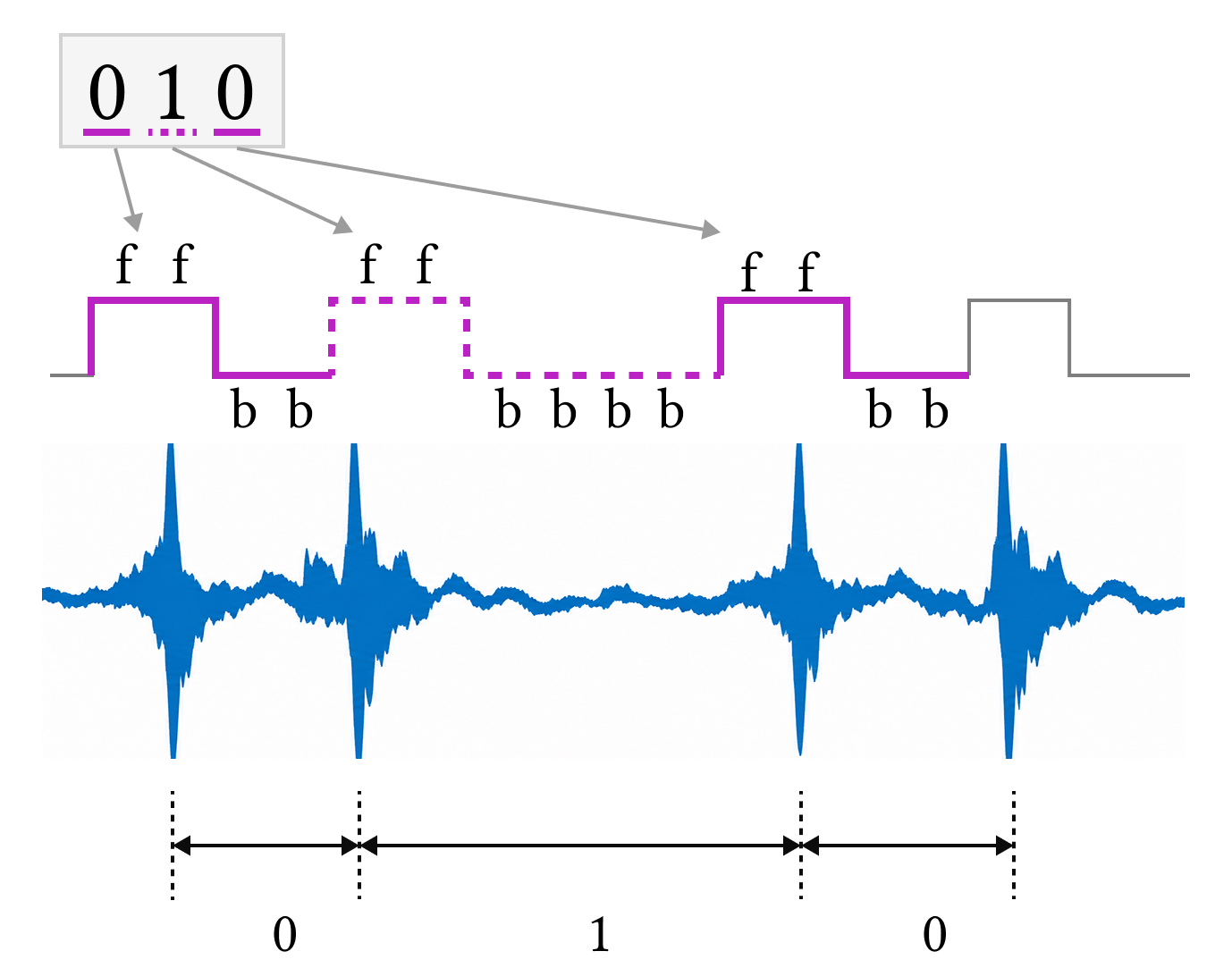
The spacing between raised regions carries the data. Two front-bed rows stay fixed, while the number of back-bed rows changes the acoustic interval shown in the diagram.
Short interval
2 front-bed rows + 2 back-bed rows
Long interval
2 front-bed rows + 4 back-bed rows
Encoding Workflow
Convert the source to binary
A number or UTF-8-encoded text becomes a sequence of 0 and 1 symbols.
Expand bits into bed-row intervals
pattern-generator.js maps each bit to its front-/back-bed run, adds margins and repeated marker structure, and creates inverse upper and lower halves.
Generate a machine-readable image
The generator writes a red/green PNG in which color identifies front- and back-bed knitting.
Translate pixels into machine operations
image-kp.js reads the bed assignment, inserts loop transfers where needed, and outputs a Knitout .k program for the knitting machine.
Open-source tool: image-kp.js in CMU Textiles Lab's Knitout Examples ↗ converts a color-coded image into a knit/purl sheet in Knitout format.
Decoding Workflow
Record the raised structure
A probe with a contact microphone slides across the fabric, and its piezo signal is captured through the USB audio interface.
Expose the contact events
The raw waveform passes through fourth-order 50 Hz high-pass and 500 Hz low-pass Butterworth filters, then its absolute value is taken.
Measure the acoustic spacing
Peaks above 40% of the processed global maximum are detected with at least 40 ms separation. The decoder measures every peak-to-peak interval.
Recover the binary sequence
Deterministic one-dimensional K-means splits intervals into short 0 and long 1 clusters, then concatenates the labels into a bit string. The current decoder reads all detected intervals in the selected recording window.